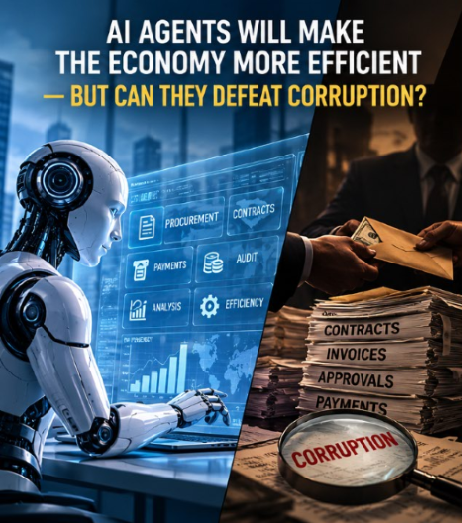
Artificial Intelligence is entering a new phase. We are moving from AI systems that simply answer questions to AI agents that can act, decide, coordinate, compare options, monitor transactions, and complete tasks on our behalf. Some technology leaders predict that AI agents will remove enormous amounts of inefficiency from the global economy. That sounds revolutionary, but what does it really mean? And an even more important question follows: If AI can eliminate economic inefficiency, can it also eliminate corruption?
The answer is complicated. AI could remove a great deal of waste, friction, delay, and poor coordination. It could also become one of the most powerful anti-corruption tools ever created. But corruption is not merely inefficiency. It involves power, incentives, secrecy, and deliberate abuse. Understanding that distinction is essential if we want to use AI intelligently in public governance.
What Economic Inefficiency Really Means
Much of modern economic activity involves people performing coordination work rather than actually producing goods or services. Businesses spend enormous amounts of time requesting quotations, comparing suppliers, approving purchases, checking invoices, managing contracts, arranging transportation, preparing reports, reconciling accounts, and following up on delayed decisions. Governments operate in much the same way, but often on a much larger scale.
Suppose a government department wants to purchase 10,000 computers. Officials may have to prepare specifications, invite bids, answer questions, compare suppliers, verify eligibility, obtain approvals, prepare contracts, receive goods, inspect deliveries, process invoices, and authorize payment. Dozens of people may become involved, and the process may take weeks or months.
Advanced AI agents could eventually perform much of this work automatically. They could compare hundreds of suppliers, examine previous contracts, verify qualifications, analyze market prices, identify unusual conditions, check compliance rules, draft documents, and monitor delivery. This is what people generally mean when they say AI could remove economic inefficiency.
AI could dramatically reduce the cost of paperwork, administrative delays, information searches, contract management, accounting, procurement, supply-chain coordination, regulatory compliance, fraud detection, customer service, inventory management, and auditing. Economists often describe many of these activities as transaction costs, and AI has the potential to reduce them substantially.
Why Corruption Is Different
Corruption creates inefficiency, but corruption itself is usually intentional. Consider a government construction project. Suppose a qualified company offers to build a bridge for $80 million, while another company offers to build it for $110 million. The second company receives the contract because someone involved in the decision receives a secret payment.
From an economic perspective, the government has wasted $30 million. But this is not simply poor management. Someone benefited from the inefficiency, and that distinction matters enormously. AI can help fix accidental inefficiency relatively easily. It is much harder to eliminate inefficiency that powerful people deliberately create for personal benefit.
AI Could Still Transform the Fight Against Corruption
Although AI cannot eliminate greed or abuse of power, it can dramatically improve our ability to detect suspicious behavior. Corruption thrives when information is hidden, fragmented, complicated, or poorly monitored. AI performs particularly well in exactly those environments.
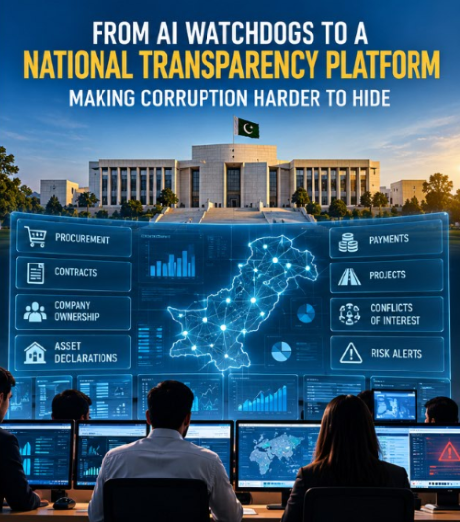
An advanced AI system could continuously examine government contracts, procurement records, company ownership, bidding histories, project costs, political connections, asset declarations, tax records, property records, beneficial ownership information, and unexplained financial relationships. Instead of examining a few hundred transactions each year, AI could examine millions.
Imagine an AI agent reviewing every government procurement contract and asking: Is the price reasonable? Why did this company win? Are competing bidders connected to each other? Does the winning company have links to officials responsible for awarding the contract? Has the same company repeatedly won unusually favorable contracts? Have project costs suddenly increased? Are there signs of conflict of interest?
Human auditors cannot realistically perform this level of continuous monitoring. AI can.
From Periodic Auditing to Continuous Auditing
Traditional government auditing usually happens after the event. Money is spent, projects are completed, and years later an audit may identify irregularities. By then, recovering the money may be extremely difficult.
AI changes that model. Instead of auditing after the transaction, AI agents could monitor transactions while they are happening. A traditional audit might say, “This contract awarded three years ago appears to have been overpriced.” An AI monitoring system could instead say, “Warning: This proposed contract is 32 percent above comparable market prices. Two bidding companies appear to share common beneficial ownership. The winning bidder has repeatedly received contracts from the same department.”
The second warning arrives before public money disappears. That could fundamentally change government accountability.
Corruption Becomes Harder When Detection Becomes Cheap
One of the reasons corruption survives is that investigating it is expensive. Governments may process millions of contracts, invoices, payments, permits, licenses, and financial transactions, and no human organization can examine every transaction carefully. Corrupt actors depend on that limitation. They assume that nobody will examine the thousands of documents surrounding their activities.
AI changes that assumption. If every invoice, contract, company, property transaction, and procurement decision can be automatically analyzed, the probability of detection rises dramatically. The question for a corrupt official would no longer be, “Will anyone notice?” It may become, “How can I hide this when every transaction is automatically analyzed?” That is a very different world.
But AI Cannot Solve the Problem Alone
There is one serious limitation. AI can discover suspicious activity, but it cannot guarantee that society will act on that information. Suppose an AI system identifies corruption involving a powerful politician, senior bureaucrat, military official, judge, or businessman. What happens next?
If institutions are independent, the information may trigger an investigation. But if powerful people control investigators, regulators, auditors, or courts, the warning may simply be ignored. That means AI cannot replace independent courts, investigative journalism, professional auditing, transparent procurement rules, conflict-of-interest laws, whistleblower protection, and credible enforcement agencies.
AI can strengthen these institutions enormously, but it cannot substitute for them.
The Real Opportunity
The most important promise of AI may therefore not be that it will eliminate corruption. Its greatest contribution may be that it makes corruption much more difficult to hide. For centuries, corrupt systems have survived because information was scattered across thousands of files, departments, databases, and institutions. AI agents can connect those dots.
And that leads directly to an idea I believe deserves serious consideration: creating a National Transparency Platform capable of monitoring government transactions continuously. Such a platform could combine public data, procurement records, ownership information, government contracts, asset declarations, project costs, and financial patterns into one intelligent monitoring system.
Instead of relying entirely on occasional investigations, society could build a permanent digital watchdog. That possibility deserves a deeper discussion, and that is where Part Two begins. Stay tuned for my next blog!

Leave a Reply