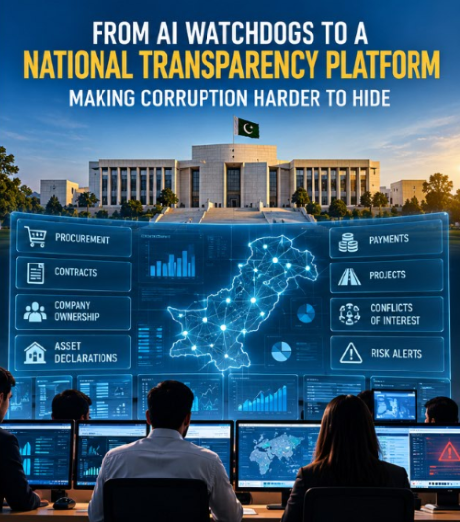
If AI agents can monitor millions of financial transactions, contracts, companies, and government decisions simultaneously, we should ask a much bigger question: Why not build AI specifically to protect public money?
The idea is not to assume that technology will magically eliminate corruption. It will not. The more realistic objective is to use AI to make corruption much harder to conceal, much easier to detect, and much riskier to attempt. That objective could eventually lead to something far more ambitious: a National Transparency Platform.
The Difference Between Accidental and Deliberate Inefficiency
Some economic inefficiencies are accidental. A shipment is delayed because departments failed to communicate. A government agency orders equipment it already owns. A hospital pays too much because nobody compared suppliers properly. Nobody necessarily intended these mistakes, and AI can solve many of them quite easily.
But another category of inefficiency is deliberate. A procurement process may deliberately be made complicated because complexity makes manipulation easier. Tender specifications may be written to favor a particular company. Contract prices may be inflated so that money can be diverted elsewhere. Someone benefits from these inefficiencies. That is corruption.
AI cannot remove the human desire for money, influence, favoritism, or power. But it can make the mechanisms used to conceal corruption far easier to uncover.
Imagine Millions of Digital Watchdogs
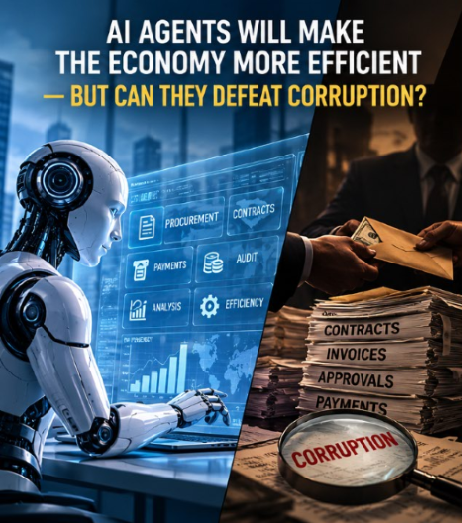
Traditional anti-corruption agencies are limited by people, time, budgets, and politics. AI agents do not have those same limitations. Imagine a government transparency system containing specialized AI agents: one continuously checks prices, another examines company ownership, another searches for conflicts of interest, another compares procurement contracts, another tracks suspicious changes in project costs, and another examines whether supposedly competing companies are actually connected.
Each individual signal may mean nothing. But combined together, they may reveal patterns that no single investigator could easily discover. This is where AI becomes extraordinarily powerful.
What a National Transparency Platform Could Do
A National Transparency Platform could bring together information that is normally scattered across different institutions. It could analyze government procurement, public contracts, project expenditures, bidding records, beneficial company ownership, government suppliers, asset declarations, property records, conflicts of interest, tax information where legally permitted, and historical spending patterns.
The system would not automatically declare someone corrupt. That would be dangerous and unfair. Instead, it would identify risk indicators and suspicious patterns requiring human investigation.
For example, the system might produce an alert stating that a government infrastructure contract worth Rs 8.4 billion appears 34 percent above comparable projects, that two supposedly competing bidders share connections through beneficial ownership, that the winning company has received several contracts from the same department during the previous year, and that a company director has a documented relationship with an official involved in procurement oversight. The recommended action would not be conviction, but independent review.
That distinction is important. The AI identifies anomalies. Investigators determine what they mean.
Transparency Before Money Is Spent
Perhaps the greatest improvement would be moving from post-mortem accountability to preventive accountability. Most anti-corruption systems operate after money has disappeared. An investigation discovers that a project was overpriced. A newspaper uncovers hidden ownership. An auditor identifies irregular contracts. A parliamentary committee investigates several years later. By then, the damage has occurred.
A National Transparency Platform could operate earlier. Before approving a large transaction, the system could automatically check whether the price is consistent with market prices, whether enough companies were allowed to compete, whether bidders appear genuinely independent, whether any bidder has connections with decision-makers, whether the contract specification has been unusually narrowed, and whether a supplier has repeatedly received government contracts under questionable circumstances.
These checks could become automatic. That would fundamentally change procurement.
The AI Arms Race
There is another uncomfortable reality. AI will not only help investigators; it will also help corrupt actors. Artificial intelligence could potentially be used to create false invoices, disguise financial relationships, structure shell companies, manipulate paperwork, or hide suspicious transactions.
Future corruption may therefore become more technologically sophisticated. We may eventually see something resembling an arms race: AI-assisted corruption versus AI-assisted transparency. The solution is not avoiding AI. The solution is building better transparency systems first.
Who Controls the System?
This may be the most important question of all. A powerful transparency system becomes useless if political leaders can simply disable investigations involving themselves or their allies.
Therefore, a credible National Transparency Platform would require strong institutional safeguards. Its algorithms should be auditable, its data sources clearly documented, its risk indicators transparent wherever possible, and its findings preserved so they cannot quietly disappear. Independent institutions should have access to its reports, and no single political authority should be able to decide which transactions the system is allowed to examine.
The objective should be simple: The system follows the money regardless of who controls it.
Human Judgment Must Remain
AI should never become judge, jury, and prosecutor. There are legitimate reasons why government transactions sometimes look unusual. A project may cost more because of difficult geography. A company may repeatedly win contracts because it genuinely provides better service. A relationship between individuals may be entirely innocent.
Therefore, AI should flag risks, not pronounce guilt. Human investigators, auditors, courts, journalists, and oversight institutions must interpret the evidence. This combination is far stronger than either humans or machines acting alone.
From Anti-Corruption Agency to Transparency Infrastructure
This is the larger idea behind a National Transparency Platform. Countries traditionally create agencies to investigate corruption, but perhaps the future requires something different. Instead of creating only another agency, we should create national transparency infrastructure.
Just as countries build highways, electricity networks, banking systems, and digital identity systems, governments could build digital systems that continuously protect public resources. Every major government transaction could leave an auditable digital trail. AI agents could monitor those trails continuously, while citizens, journalists, auditors, regulators, and courts could use the resulting information.
This would not guarantee the disappearance of corruption. But it could dramatically increase the probability that corruption is discovered.
The Real Promise of AI
When people say that AI will eliminate economic inefficiency, we should be careful not to exaggerate. AI will not eliminate greed, conflicts of interest, or dishonest governments. But it can dramatically reduce the cost of detecting waste, fraud, abuse, and suspicious behavior.
That alone could transform governance. For centuries societies have struggled with the same question: Who watches the people who control public money?
AI gives us the possibility of creating millions of tireless digital watchdogs. But technology provides only the eyes. We still need independent institutions, laws, transparency, accountability, and the willingness to act upon what those eyes discover.
That is why I believe the long-term objective should not simply be “using AI against corruption.” It should be something much more systematic: build a National Transparency Platform that makes every significant government transaction easier to examine, easier to question, and much harder to hide.
And although I am proposing this idea with Pakistan in mind, its potential is much broader. Once such a platform is successfully designed, tested, and proven, the same basic model could be adapted by governments, watchdog organizations, journalists, civil society groups, and international institutions around the world. Corruption is not a Pakistani problem; it is a global problem. A well-designed National Transparency Platform could therefore become more than a national reform project—it could become a global framework for using AI to protect public money and strengthen accountability wherever governments operate.
AI may not eliminate corruption, but properly designed, it could make corruption a far more dangerous game to play.

Leave a Reply