Oct 20, 2026
Blog 1 of the SpaceX series for TheNationHasAwoken.com. It stands alone, so readers need no other post to follow it.
Disclaimer: This post is for education only. It is not financial advice.
A Rocket That Comes Home
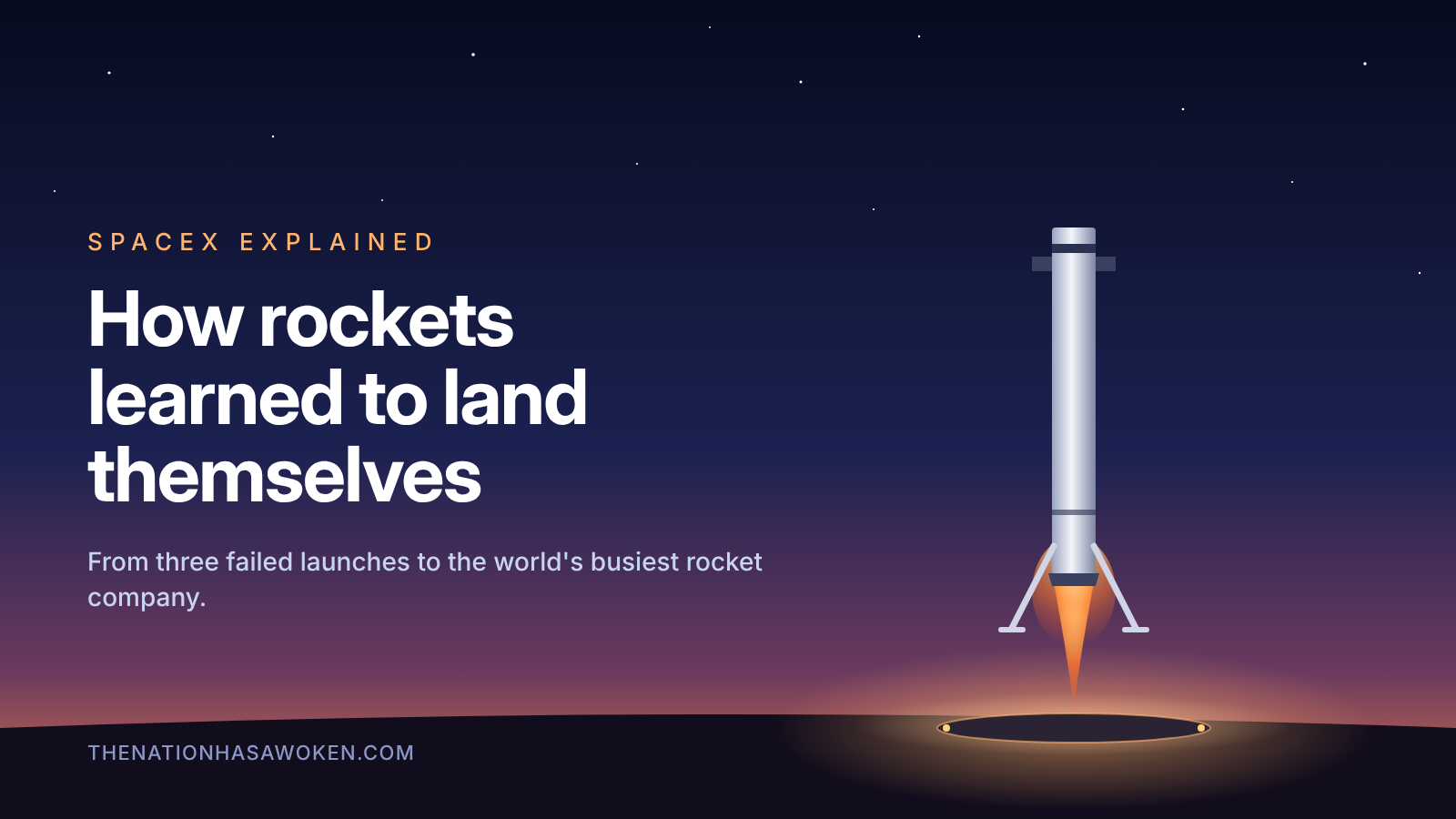
Picture this. A rocket booster as tall as a 14-storey building falls back from the edge of space. It flips around, fires its engines, unfolds four legs, and lands gently on a concrete pad. Then it gets checked, refueled and flown again.
That sounds like science fiction. It is actually a normal Tuesday at SpaceX.
In this post, I explain SpaceX in plain words. What is it? Where did it come from? Why does everyone talk about it? And why should you care, whether you are a curious reader, a student, or someone thinking about SpaceX stock? No rocket science degree required. I promise.
What Is SpaceX, in Simple Words?
SpaceX is an American company that builds rockets and spacecraft. It launches satellites, carries astronauts to the International Space Station, runs Starlink, an internet service beamed down from space, and builds artificial intelligence. Next, it wants to put data centers in orbit.
Its full name is Space Exploration Technologies Corp. Elon Musk founded it in 2002. Yes, the same Elon Musk of Tesla fame. The man clearly does not believe in hobbies that fit in a garage.
The Origin Story: Three Failures and a Lifeline
SpaceX did not start as a success story. It started as a near-disaster.
Its first rocket, the small Falcon 1, failed on its first launch in 2006. It failed again in 2007. It failed a third time in 2008. By then, the company was running out of money fast.
Then came September 28, 2008. Launch number four. The money was almost gone, and so was everyone’s patience. If this one failed, SpaceX was finished. The engines roared, the rocket climbed, and this time it did not stop. History was made. Falcon 1 became the first privately built liquid-fueled rocket to reach orbit.
A few months later, NASA gave SpaceX a contract worth about $1.6 billion to carry cargo to the space station. That contract saved the company. The lesson is worth remembering: persistence, plus one good customer, can turn failure into a business.
The Mission: A “Backup Copy” of Humanity
SpaceX says its goal is to make humanity “multiplanetary.” In plain words, that means people living on more than one planet, starting with Mars.
Why? Think of it like backing up your phone. If something terrible happens to Earth, a second home keeps the human story going. It is a bold idea, and some call it a fantasy. But it explains why SpaceX keeps building bigger and bigger rockets.
The Big Idea: Stop Throwing Rockets Away
Here is the idea that changed the space industry.
For decades, rockets were used once and thrown away. Imagine flying from Karachi to Dubai and then scrapping the plane on arrival. Tickets would cost a fortune. That is how space travel worked.
SpaceX asked a simple question: why not land the rocket and fly it again?
- 2015: SpaceX landed a Falcon 9 booster after a launch for the first time.
- 2025: it made 165 orbital launches, all on Falcon 9. That is more than three rocket launches every single week, all year long. China, the world’s second-busiest space nation, managed only about half as many with all its rockets combined.
- August 2026: a single booster flew for the 37th time, a new record.
Reuse makes each launch much cheaper. Cheaper launches mean more customers. More customers mean more launches. It is a simple loop, and it is very hard for rivals to copy.
How a Company Ended Up Doing a Government’s Job
Space used to belong to governments. Only countries like the United States and Russia could afford it.
SpaceX flipped that model. Instead of building its own rockets, NASA now buys rides from SpaceX, like a passenger booking a taxi. In 2020, SpaceX’s Dragon capsule carried NASA astronauts to the space station. It was the first time astronauts had launched from American soil since the Space Shuttle retired in 2011.
Today, governments, telecom companies and even other countries’ satellites ride on SpaceX rockets. The taxi has become the airline. A taxi takes one passenger, one trip at a time. An airline runs a busy schedule, and many passengers share each flight and its cost. SpaceX now works the same way. It flies several times a week. On its “rideshare” missions, dozens of small satellites from different customers share one rocket and split the bill. That makes space affordable for universities, start-ups and smaller countries too.
SpaceX Today: Three Businesses Under One Roof
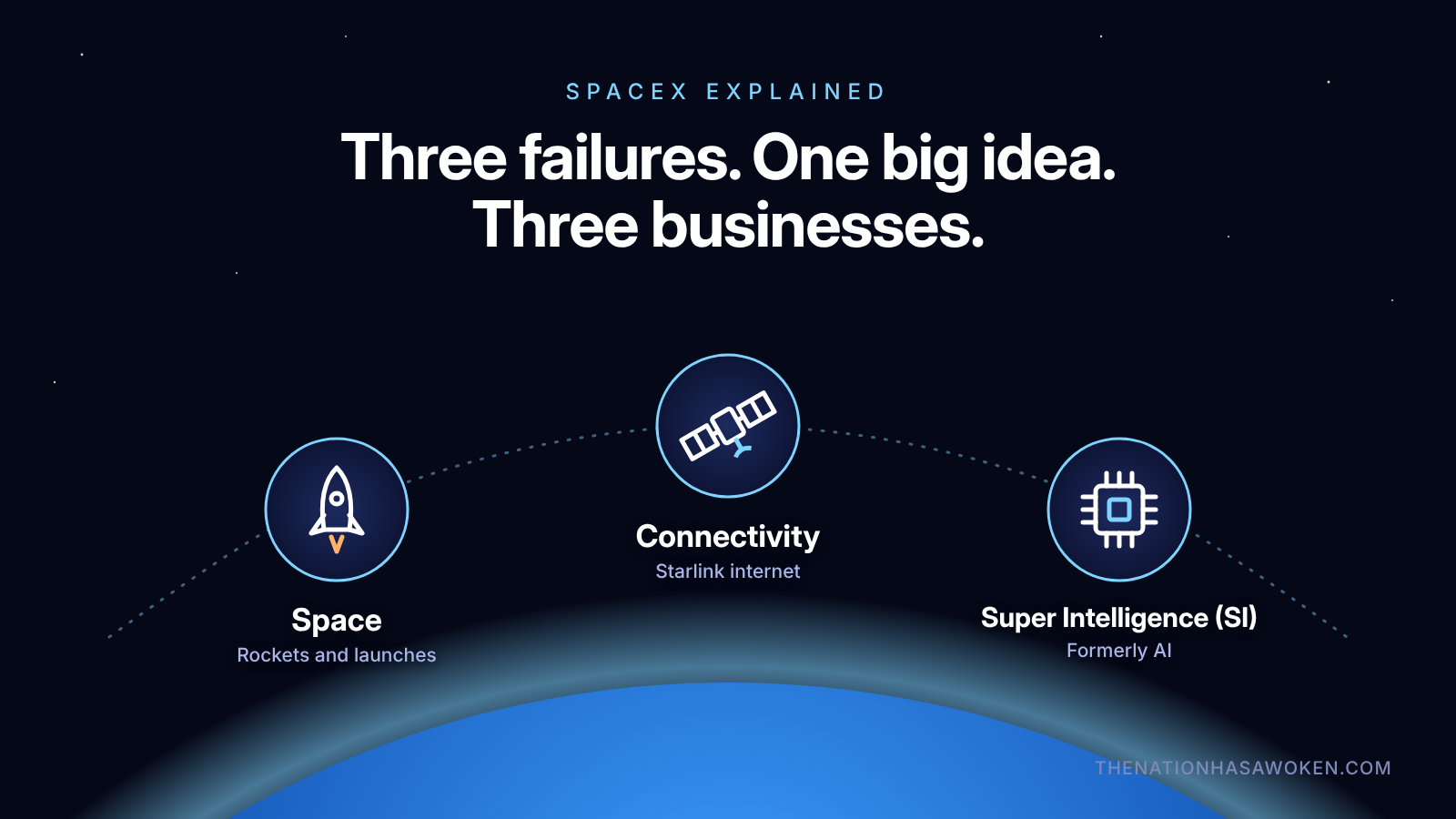
SpaceX is no longer just a rocket company. It now has three parts:
- Space: rockets, launches, the Dragon capsule, and the giant Starship still in testing.
- Connectivity: Starlink, its satellite internet service, which reaches millions of homes and businesses.
- Super Intelligence (SI, formerly AI): the former xAI, Musk’s artificial intelligence company, which merged into SpaceX in February 2026. This segment used to be called simply “AI.” SpaceX renamed it “Super Intelligence” (SI) in its October 2026 results. It now brings in just over half of SpaceX’s revenue.
And SpaceX is already planning what comes next:
- Data centers in space: AI needs huge amounts of computing power and electricity. SpaceX’s answer is to put the computers in orbit, run them on almost non-stop sunshine, and let them cool off into space. It has asked US regulators for permission to launch up to one million such satellites. The first, called AI1, are due to launch in late 2027.
- Terafab, its own chip factory: all those computers need chips, and the world’s chip factories are already stretched. So SpaceX and Tesla are building Terafab, a giant chip plant in Texas, to make their own AI chips. Musk hopes for a first test chip in mid-2027 and mass production in late 2028.
- The Moon and Mars: Starship is meant to land NASA astronauts on the Moon, and one day carry people to Mars.
In June 2026, SpaceX became a public company. Its shares now trade on Nasdaq under the ticker SPCX. At its stock market debut, it was valued at about $1.75 trillion. Not bad for a company that nearly went bust in 2008.
What the World Can Learn From SpaceX
I cannot write about SpaceX without asking: what is in it for us?
You do not need a rocket to use SpaceX’s playbook. Governments, companies and individuals anywhere can borrow three lessons:
- Treat failure as tuition. SpaceX failed three times before it succeeded. Too many institutions, public and private, punish honest failure so hard that nobody dares to try.
- Government as a smart customer. NASA did not build everything itself. It decided to stay away from such large ventures, rightly so, and paid private companies for results. Any government can do the same, in space, IT or public services.
- Cut costs through new thinking. Reusable rockets came from asking “why do we do it this way?” That question is free, and every organization should ask it more often.
Investor Takeaway
For investors, the message is simple. SpaceX’s “moat,” its hardest-to-copy advantage, is reusability. It lets SpaceX launch more often, and more cheaply, than anyone else.
But a strong moat does not make a stock cheap. The good news: in the third quarter of 2026, SpaceX earned a $4.4 billion profit on $14.6 billion of revenue. That was its first quarterly profit as a public company. But about $1 billion of it came from a rise in bitcoin prices. SpaceX is also spending heavily on AI data centres and Starship, and Elon Musk holds most of the voting power. Look at the numbers, the risks and your own goals before making any decision.
The Final Word
SpaceX began with three failed launches and a nearly empty bank account. Today, it lands rockets like aircrafts and is one of the most valuable companies on Earth.
The real story is not about rockets. It is about refusing to accept “this is how it has always been done.”
What do you think: is SpaceX a bold vision or an expensive dream? Share your thoughts in the comments. And if this helped you, pass it on to a friend who still thinks rockets are single-use.


Leave a Reply