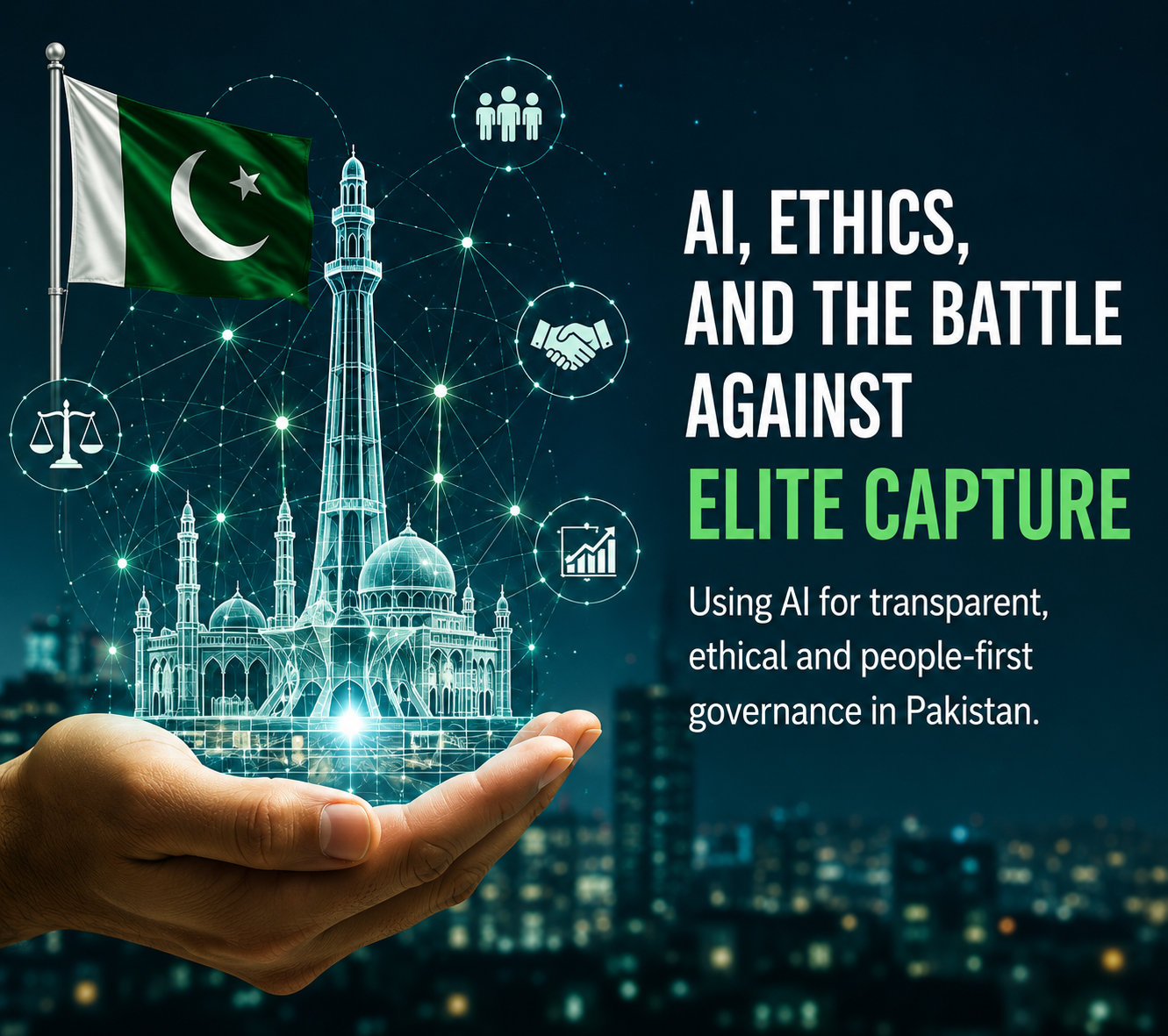
Can Technology Help Build a More Honest Pakistan?
For years, I have watched Pakistan struggle with the same problems. Governments change, political slogans change, and faces on television change, yet many of the underlying issues remain stubbornly intact. Corruption persists, public services remain weak, merit often loses to connections, and the wealthy and powerful continue to enjoy privileges unavailable to ordinary citizens. Many Pakistanis describe this phenomenon as elite capture—a situation where a small group controls the political, economic, and administrative machinery of the country primarily for its own benefit rather than for the benefit of the people.
The question is simple: Can Artificial Intelligence help Pakistan escape this cycle? My answer is yes—but only if AI is used as a tool to strengthen ethics, transparency, accountability, and the rule of law. AI will not magically create honest leaders, but it can make dishonesty far more difficult.
The Real Problem Is Not Technology
Before discussing AI, we must identify the real problem. Pakistan’s biggest challenge is not a lack of intelligence, resources, or laws. The real challenge is that incentives are often misaligned. Many systems reward influence rather than merit, and many important decisions occur behind closed doors. Whenever decision-making lacks transparency, corruption flourishes.
The first objective of any AI-driven governance initiative should therefore be simple: make every important government decision visible and traceable. Once citizens can see how decisions are made, corruption becomes much harder to hide.
Creating a National Transparency Platform
Imagine a single digital platform where every major government transaction is recorded, analyzed, and made available for public scrutiny. Government contracts, procurement decisions, development projects, land allocations, tax exemptions, public-sector hiring, subsidies, and expenditures could all be monitored through this system.
AI could continuously examine these transactions and identify unusual patterns. Why does one contractor repeatedly receive government projects while others receive none? Why has the cost of a public project suddenly tripled? Why are certain individuals or companies consistently favored? Instead of waiting years for audits, AI could generate alerts within minutes. The goal would not be automatic punishment but automatic scrutiny. And scrutiny is one of the most effective weapons against corruption.
Following the Money
Corruption often survives because money is hidden within complex networks of individuals, companies, and institutions. AI excels at finding patterns in enormous datasets. By connecting information from tax records, land ownership databases, corporate registrations, customs records, government contracts, and legally authorized financial investigations, AI could help identify suspicious relationships between public office and private gain.
If a government official awards contracts to a company secretly connected to family members or close associates, AI could flag the relationship almost immediately. Investigations that currently take months or even years could begin within hours. The objective would not be mass surveillance of citizens but rather increased accountability for those entrusted with public resources.
Making Government Hiring Merit-Based
One of the most damaging forms of corruption is favoritism in hiring and promotions. When appointments depend on personal connections rather than competence, entire institutions become weaker over time. AI can help create a merit-driven recruitment system by anonymizing applications during the initial evaluation process, matching qualifications against objective job requirements, and documenting every stage of the selection process.
Human judgment would still be necessary, but the opportunity for manipulation would be greatly reduced. The result would be a public sector staffed by more qualified individuals, leading to stronger institutions and better services for citizens.
An AI Guardian for Public Projects
Pakistan spends billions of rupees on development projects every year. Unfortunately, many projects suffer from delays, inflated costs, poor-quality work, or incomplete implementation. AI can serve as a constant watchdog by monitoring budgets, timelines, contractor performance, material costs, satellite imagery, and project milestones.
Imagine a road project scheduled for completion within twelve months. Satellite images show little progress after eight months, yet invoices indicate that most of the allocated budget has already been spent. An AI system could immediately identify the discrepancy and alert investigators. Instead of discovering problems years later through audit reports, authorities could intervene while the project is still underway, saving both time and public money.
Bringing Ethics into Government Decisions
Many people worry that AI will replace human decision-makers. That should never be the goal. Instead, AI systems should be designed and governed according to Responsible AI principles such as fairness, transparency, accountability, and privacy. These principles ensure that AI platforms do not reinforce existing biases or power imbalances, but instead promote trust, protect citizens’ rights, and support ethical and inclusive decision‑making—ultimately making the system more credible and effective in achieving its purpose.
Governance requires wisdom, judgment, and moral responsibility—qualities that machines do not possess. However, AI can serve as an ethical assistant to policymakers.
Before major policies are implemented, AI systems could evaluate who benefits, who may be harmed, whether resources are being distributed fairly, and whether proposed actions align with constitutional principles. The system would not make decisions but would provide ethical impact assessments. Just as environmental impact studies have become common for large projects, ethical impact assessments could become a routine part of government decision-making. Such a process would encourage leaders to think beyond short-term political gains and focus on long-term public welfare.
Empowering Citizens Instead of Bureaucracies
One of the greatest strengths of AI is its ability to reduce the distance between citizens and government. Imagine a national platform where citizens can report broken roads, missing medicines, corrupt officials, water shortages, or absentee teachers using a mobile application. AI could automatically categorize complaints, identify patterns, prioritize urgent issues, and route them to the appropriate authorities.
If thousands of complaints emerge from a particular district, decision-makers would know immediately. Problems that currently disappear into bureaucratic black holes would remain visible until they are resolved. In this way, AI would shift power away from bureaucracy and toward citizens.
Breaking the Yoke of Elite Capture
Perhaps the greatest contribution AI can make is helping Pakistan break free from elite capture. Elite capture survives because information, influence, and decision-making power remain concentrated in the hands of a small group. The solution is not replacing one elite with another. The solution is democratizing information.
AI can help create public dashboards displaying government spending, tax collection, development project progress, education outcomes, healthcare performance, legislative attendance, and public service delivery metrics. When citizens have access to accurate and timely information, they become informed participants rather than passive observers. Information is power, and AI can help distribute that power more evenly across society. The more transparent the system becomes, the harder it becomes for any group to manipulate it for private gain.
The Necessary Safeguards
AI is not automatically ethical. In the wrong hands, it can strengthen authoritarianism rather than accountability. That is why strong safeguards are essential. Every AI governance initiative should include independent oversight, judicial review, transparent algorithms, privacy protections, public accountability mechanisms, and meaningful human supervision.
The objective is not to create an all-seeing digital state. The objective is to create an accountable state. There is a profound difference between the two.
A Vision for Pakistan’s Future
I do not believe AI alone will solve Pakistan’s problems. Technology is only a tool. The deeper solution still lies in values such as integrity, justice, accountability, merit, and service to the public. However, AI can help institutionalize these values in ways that were previously impossible. It can shine light into areas where corruption thrives, expose favoritism, reveal waste, empower citizens, and strengthen transparency.
Pakistan does not merely need smarter technology—it needs smarter governance. If Artificial Intelligence is designed around ethics, transparency, and service to the people, it could become one of the most powerful tools ever created to break the cycle of elite capture and move the country toward a future where government genuinely serves its citizens. That would not simply be a technological revolution. It would be a governance revolution.


Leave a Reply