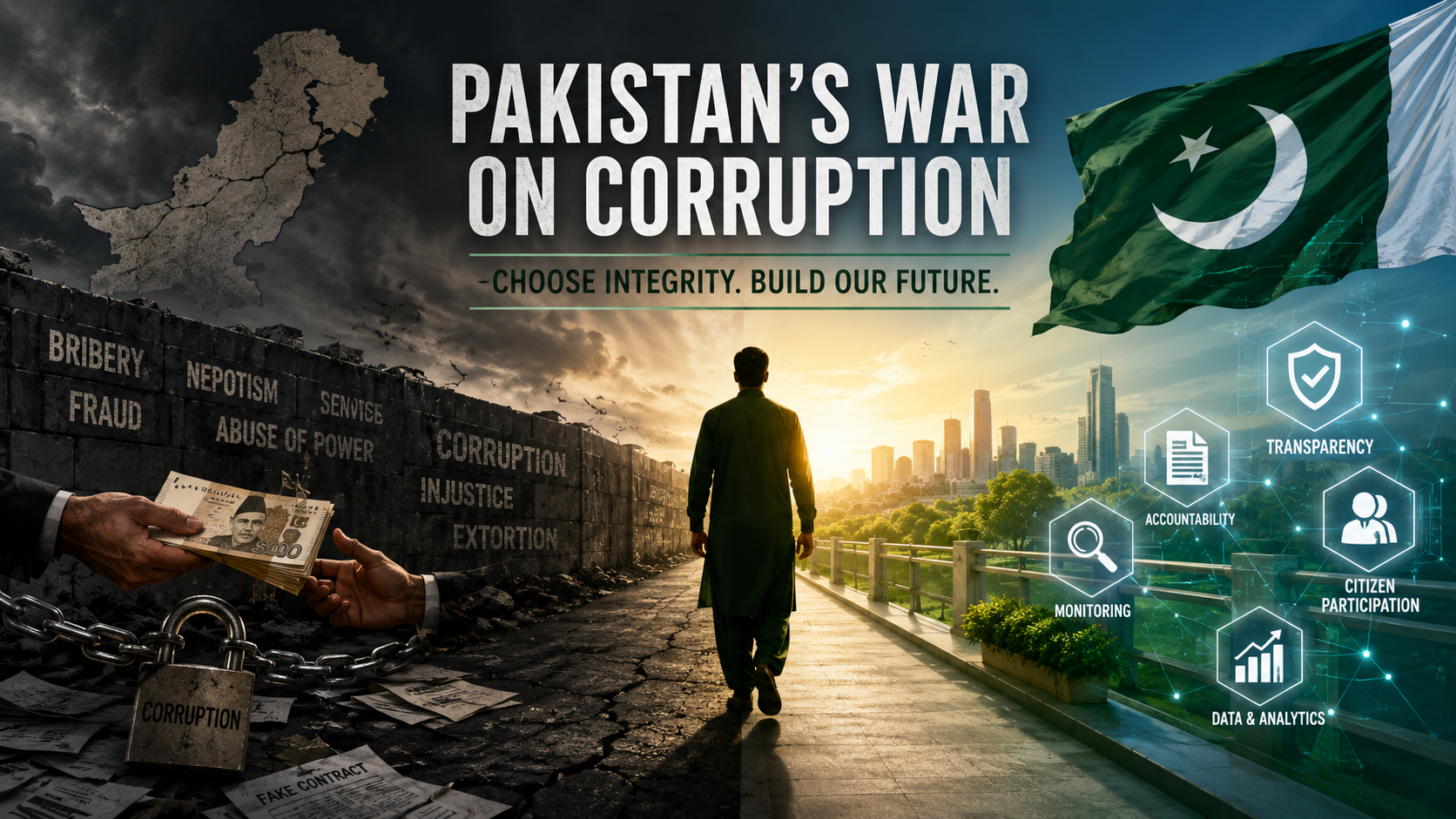
Why Corruption Must Never Become Normal
Corruption is often discussed in Pakistan with a helpless shrug: “This is how the country works,” “Everyone is corrupt,” or “Nothing can be changed.” I have heard these arguments many times, but I cannot accept them. If an action is dishonest, harmful, exploitative, and ethically wrong, how does its widespread practice suddenly make it acceptable? Theft does not become respectable when it is organized. Bribery does not become ethical when it is described as a custom. Abuse of public authority does not become public service simply because it has continued for decades.
Corruption may never be eliminated entirely. Every country has greedy individuals, dishonest officials, compromised businesses, and political opportunists. Human weakness cannot be removed from society. Yet there is a vast difference between occasional corruption that is detected and punished, and systemic corruption that becomes an unofficial method of running a country. Pakistan must therefore make the reduction of corruption a national priority. Before discussing laws, institutions, artificial intelligence, or a National Transparency Platform, we must settle a more basic question: Do we still believe corruption is wrong?
Corruption Must Remain Socially Unacceptable
The most dangerous stage of corruption is reached not merely when corrupt people steal large amounts of money, but when ordinary people stop being disturbed by it. A citizen pays an official to obtain a legitimate document. A contractor inflates the cost of a road. A politically connected company receives a government contract. An inspector ignores violations after receiving money. A public project looks magnificent in official files but is barely visible on the ground.
Gradually, society adjusts. Parents advise their children to develop contacts rather than competence. Businesspeople include unofficial payments in their expenses. Young professionals conclude that merit matters less than influence. Public office becomes an opportunity for self-enrichment instead of a responsibility held in trust. Eventually, an honest person begins to appear naïve. That is the real triumph of corruption: it does not merely steal public money; it changes society’s definition of normal behavior.
We must resist that change. Corruption should remain shameful, morally disturbing, and socially unacceptable. A person may legitimately disagree with a particular anti-corruption law, agency, investigation, or political campaign. But rejecting the basic principle that corruption is unethical should concern us deeply. It may reflect cynicism, moral confusion, normalization of wrongdoing, or a personal interest in preserving the existing system. Still, the fight against corruption must remain fair: disagreement alone is not proof that a person is corrupt, and accountability must always be based on evidence.
The Argument That “Everyone Is Corrupt”
I have a relative who does not believe society should strongly condemn corruption. Whenever someone speaks against it, he tries to pull that person into the same category as corrupt officials and politicians. His argument often begins with a simple question: “Have you ever sold a house in Pakistan?” If the answer is yes, he asks whether money was paid to officials handling the transaction. When the person admits that an unofficial payment had to be made because the process would otherwise have been delayed or obstructed, he announces his verdict: “You are corrupt too. A person giving a bribe is as corrupt as the person receiving it. Therefore, you have no right to speak against corruption.”
At first, this may sound logically consistent because both people participated in an improper payment. But it ignores a vital distinction between paying voluntarily to obtain an unfair advantage and paying under coercion to receive something to which one is already legally entitled. In one situation, a property developer may bribe an official to approve an illegal building, ignore safety rules, or unfairly award a contract. Both parties cooperate for mutual benefit and deliberately undermine the law. In another situation, an ordinary citizen completes every legal requirement and pays every official fee, but an official refuses to process the case without an extra payment. The citizen faces financial loss, legal complications, or months of deliberate delay. Both situations involve improper payments, but they are not morally identical. One is collusion; the other resembles extortion.
The Victim and the Beneficiary Are Not the Same
A person forced to pay a bribe may still be participating in a corrupt transaction, but that does not mean the person carries the same moral responsibility as the official demanding it. Intent, freedom of choice, personal benefit, and power all matter. The citizen is often not trying to gain an advantage over someone else. He is trying to obtain a lawful service that is being deliberately withheld by a person abusing public authority.
This does not mean paying under pressure is harmless. Such payments help keep the system functioning, and whenever a safe and realistic alternative exists, citizens should refuse, document the demand, report it, or seek legal assistance. But it is unfair to treat a powerless victim and a powerful extortionist as moral equals. A shopkeeper forced to pay protection money to a criminal gang is not considered as guilty as the gang leader merely because money changed hands. Similarly, a citizen trapped in a corrupt administrative process should not be silenced or disqualified from advocating reform. Direct experience with corruption may be the very reason that person understands how urgently change is needed.
How “You Are Corrupt Too” Protects the System
The claim that everyone is equally corrupt performs a useful service for those benefiting from the system. It destroys moral distinctions, discourages criticism, and spreads hopelessness. It suggests that because no person is perfectly innocent, no one has the right to demand improvement. By that logic, a person who once exceeded the speed limit could never support road safety, someone who made an unhealthy choice could never encourage healthy living, and a person who once remained silent in the face of injustice could never decide to speak later.
Human beings are imperfect. Reform does not require moral perfection. If only flawless people were allowed to oppose wrongdoing, every reform movement in history would have ended before it began. The real questions are whether a person knowingly seeks unfair advantages, exploits public authority, conceals wrongdoing, defends corrupt practices, or genuinely wants the system to become more honest. Someone who reluctantly paid an official to release a lawful property document can still oppose bribery. Someone who has made mistakes can still support reform. We should encourage such people rather than push them into silence.
Corruption Is Much More Than Bribery
When people hear the word corruption, they often imagine an envelope of cash passed under a table. That is only one form. Corruption also includes political favoritism, manipulation of public contracts, illegal appointments, conflicts of interest, secret commissions, selective taxation, land grabbing, regulatory protection, interference in investigations, fake development schemes, misuse of public resources, and the use of state authority for private or political benefit.
It can occur in civilian departments, elected governments, local administrations, public corporations, law-enforcement agencies, the judiciary, regulatory authorities, and defence-related institutions. No institution or individual should be declared corrupt without evidence. At the same time, no institution that uses public money or exercises public power should be placed completely beyond lawful scrutiny. Corruption becomes systemic when political leaders, officials, contractors, businesses, and influential intermediaries begin protecting one another. At that stage, the problem is no longer a collection of dishonest individuals; it becomes a network.
What Corruption Takes Away From Pakistan
Corruption is often treated as if it causes only financial loss, but its damage is far broader. Money intended for schools, hospitals, roads, clean water, electricity, and public transport is diverted, wasted, or spent on inferior work. Citizens pay twice: first through taxes and then through poor services. Honest businesses lose contracts to politically connected bidders or companies willing to pay commissions, which discourages domestic enterprise and foreign investment.
Corruption also replaces merit with influence. When employment, promotion, contracts, and licenses depend on connections, capable people are pushed aside. Some leave the country; others stop trying. The rule of law is weakened because powerful people can purchase protection, and ordinary citizens begin to believe that justice is available only to those with money or institutional influence.
The damage reaches national security as well. A country is not made secure merely by weapons and uniformed forces. National security also depends on economic strength, functioning institutions, competent administration, social stability, public trust, and citizens’ confidence in the state. Corruption weakens every one of these foundations.
Perhaps its most painful effect is on national character. People begin to admire wealth without asking how it was obtained. Dishonesty is renamed cleverness. Influence becomes more valuable than integrity. Young people are taught to “manage the system” rather than improve it. A nation cannot build a healthy and prosperous future on such values.
Fighting Corruption Is Not Political Revenge
Pakistan has repeatedly witnessed anti-corruption slogans being used against political opponents. A government enters office and opens cases against previous rulers. The opposition calls the cases political victimization. When power changes hands, the direction of accountability changes as well. This is not a genuine war against corruption.Both parties know they are both corrupt but openly carry out victimization of the other.
Real accountability must be independent, evidence-based, transparent, and consistent. It must apply to allies as well as opponents, protect the rights of the accused, and distinguish clearly between an allegation and a proven offence. Otherwise, an anti-corruption campaign can itself become another form of political corruption. We should not oppose wrongdoing only when it is associated with people we dislike, nor defend it when the accused belongs to our preferred political party, institution, family, ethnic group, or social class. Wrongdoing does not become acceptable when committed by “our side.”
The First Battle Is Against Hopelessness
Corruption survives not only because corrupt people are powerful, but also because honest people become discouraged. They are told that nothing can change, reminded of their own compromises, mocked for being idealistic, and warned that confronting corruption will bring trouble but achieve nothing. This hopelessness is useful to corrupt networks. They do not need every citizen to support corruption; they only need most citizens to believe resistance is pointless.
That belief must be challenged. Many countries have reduced corruption through stronger institutions, transparent procurement, independent courts, professional civil services, digital records, investigative journalism, citizen participation, and consistent enforcement. Pakistanis are not naturally more corrupt than other people. The problem is not in our blood, nationality, religion, or culture. It lies in systems that reward secrecy, protect influence, and impose few consequences on powerful wrongdoers. Systems made by human beings can also be changed by human beings.
A Clear Moral Principle
Before Pakistan can build effective anti-corruption institutions, it must restore a simple moral consensus: Public authority is a trust, not private property. Government money belongs to the people. A public position is not a license to become wealthy. A government contract is not a reward for political loyalty. A citizen should not have to pay an unofficial fee for a lawful service. No political leader, official, judge, general, contractor, businessperson, journalist, or citizen should be placed above reasonable accountability.
This principle cannot remain limited to speeches. It must be reflected in laws, institutions, public records, education, political culture, and everyday behavior. Condemning corruption is necessary, but condemnation alone is not enough. People need safe ways to report wrongdoing. Journalists need reliable records. Auditors need connected information. Honest officials need protection. Citizens need to know where public money goes, and investigators need evidence that cannot be quietly altered or hidden.
From Moral Rejection to Practical Action
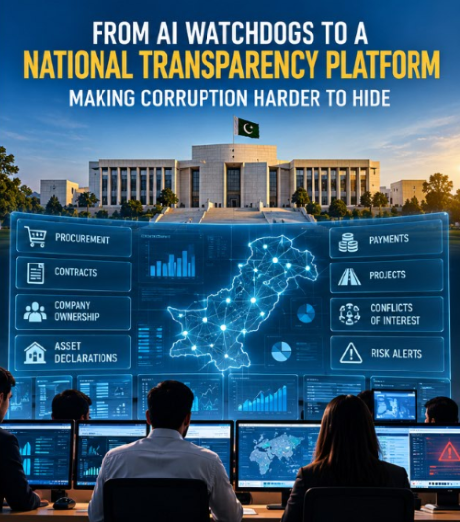
Ethical opposition to corruption must therefore be supported by a practical system. In Part 2, I will present the idea of an AI-supported National Transparency Platform: a public system designed to connect government spending, contracts, ownership records, development projects, audits, and public-service performance. Such a platform would not eliminate corruption overnight, but it could make corrupt actions more visible, more detectable, and far more dangerous for those attempting them. This is going to be a long term project with participation of many qualified team members. I will keep you updated on the progress on a regular basis.
Pakistan may never eliminate every dishonest act, but it can reduce the space in which corruption operates. It can protect honest officials, make public information visible, distinguish between victims and beneficiaries, and stop silencing reformers simply because they have been forced to survive within a flawed system. The war against corruption begins before the first investigation, court case, audit, or digital platform. It begins when citizens recover the courage to say: This is wrong. It is hurting our country. It must not be accepted. Together, we must do something about it.
Every Pakistani should participate in this conversation. Share your experience, challenge the normalization of bribery, support people who expose wrongdoing, and help build public demand for transparent governance. Corruption thrives when honest citizens are isolated. It begins to retreat when honest people recognize that they are not alone.


Leave a Reply