There are moments in a nation’s life when anger feels natural. Pakistan is passing through such a moment. Many people feel frustrated by curbs on freedom of speech, weakness in the rule of law, pressure on dissenting voices, and the growing feeling that institutions are not functioning as they should.
In such an environment, anger is understandable. But anger alone is not strategy. Anger may wake us up, but wisdom must guide what we do after we wake up. Otherwise, we simply react. We shout, insult, forward emotional messages, attack personalities, and sometimes damage the very cause we claim to defend.
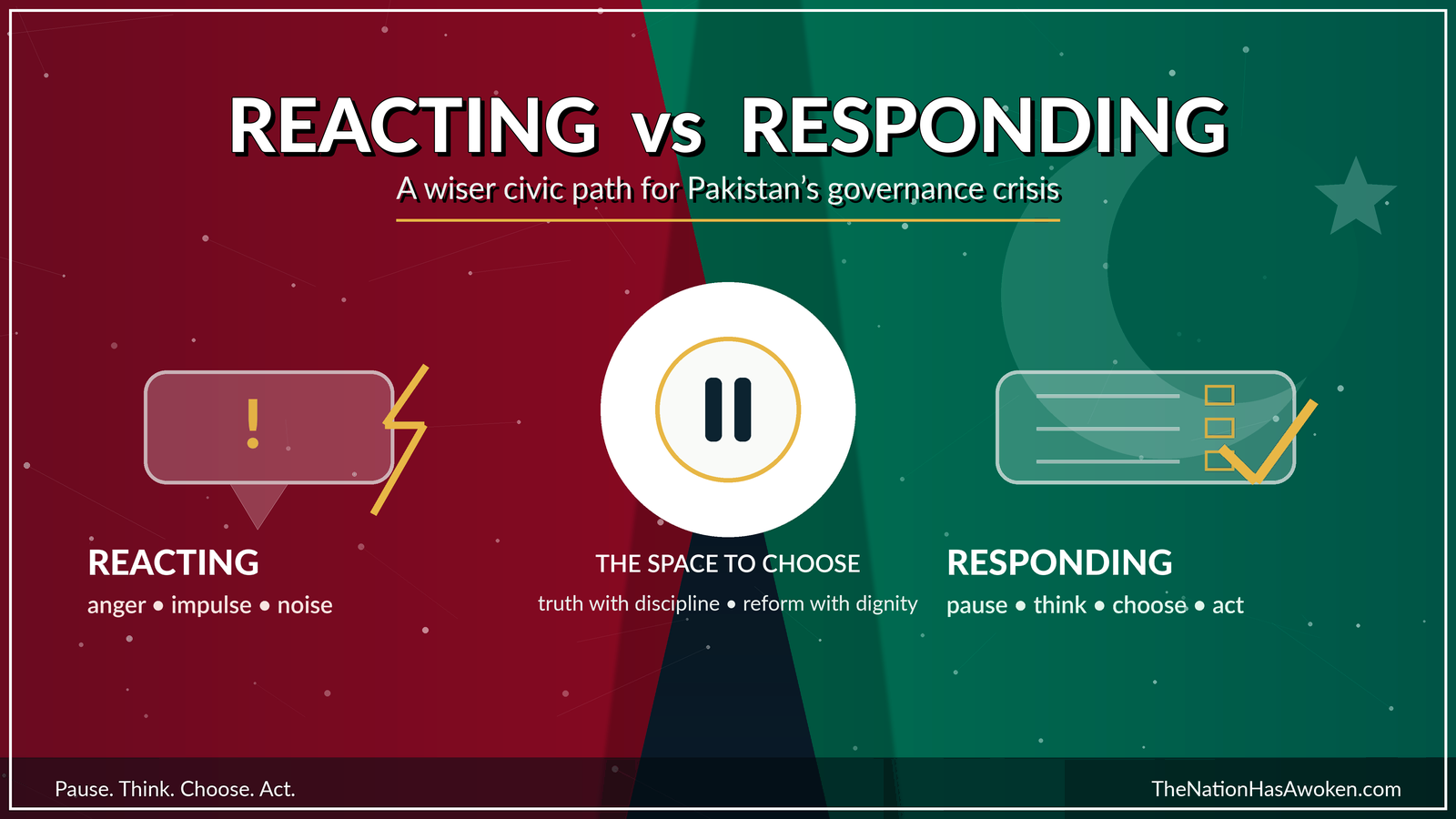
This is why we must understand the difference between reacting and responding. Reacting is immediate and emotional. Responding is thoughtful and value-based. Reacting asks, “How do I hit back?” Responding asks, “What action will actually help?” Pakistan does not need more uncontrolled reaction. Pakistan needs disciplined, ethical, and intelligent response.
The Space Between Stimulus and Response
Stephen Covey’s idea of the four human endowments gives us a useful moral framework. These endowments are self-awareness, conscience, independent will, and creative imagination. Together, they help human beings choose their response instead of being controlled by circumstances.
This is not just a personal-development idea. It is also a civic idea. A harsh political statement may be the stimulus. A court decision may be the stimulus. A news blackout may be the stimulus. A restriction on speech may be the stimulus. A provocative comment from a leader may also be the stimulus. But between that stimulus and our response, there is a space.
That space is where citizenship lives. It is where wisdom lives. It is where moral courage lives. If we lose that space, we become predictable. Someone provokes us, and we react exactly as expected. Someone spreads misinformation, and we forward it. Someone insults our side, and we insult back. That is not freedom. That is emotional remote control.
Pakistan’s Situation Requires Wisdom, Not Recklessness
Pakistan’s civic environment is deeply troubling. Many citizens feel that freedom of speech is under pressure, the rule of law is weak, and powerful people are rarely held accountable in the same way as ordinary citizens. This creates frustration, resentment, and a dangerous sense of helplessness.
But when the environment is difficult, our conduct must become more careful, not more careless. This does not mean becoming silent. Silence in the face of injustice can become cooperation with injustice. But it does mean becoming wise, disciplined, and morally clear.
We should speak truth, but not with poison. We should question power, but not with personal abuse. We should demand rule of law, but not by breaking the law ourselves. We should defend freedom of speech, but not by spreading lies. In other words, we must oppose wrongdoing without becoming wrong ourselves.
Use Self-Awareness Before Speaking
The first human endowment is self-awareness. Before we speak, post, comment, or forward anything, we should ask ourselves a few basic questions. Why am I saying this? Am I trying to help Pakistan, or am I simply trying to release my anger? Am I sharing verified information, or am I spreading something because it confirms what I already believe?
Self-awareness helps us see our own motives. It prevents us from becoming slaves of outrage. This is especially important in politics, where emotions are constantly manipulated by parties, pressure groups, media platforms, and social media mobs.
A self-aware citizen does not become a tool of propaganda, whether from the state, a political party, a media group, or an online crowd. A self-aware citizen pauses and asks, “Is this true? Is this useful? Is this ethical?” That short pause can save us from many foolish reactions.
Let Conscience Set the Boundary
The second endowment is conscience. Conscience tells us that some methods are wrong, even when the cause is right. If we believe in rule of law, we cannot promote lawlessness. If we believe in human dignity, we cannot dehumanize opponents. If we believe in freedom of speech, we cannot celebrate censorship when it is used against people we dislike.
Conscience also reminds us that justice cannot be selective. If we demand justice only for our own political side, then we are not defending justice. We are defending convenience. A true commitment to justice means defending due process, dignity, and fairness even for people whose politics we do not like.
In Pakistan’s current situation, conscience must guide both citizens and leaders. But citizens cannot control the conscience of leaders. They can only control their own. That is where real change begins: not with noise, but with moral clarity.
Use Independent Will to Act with Discipline
The third endowment is independent will. Independent will is the ability to act according to principles, even when emotions are pulling us in another direction. It is easy to become angry. It is easy to insult. It is easy to join a digital mob. It is easy to say, “Everyone else is doing it, so why not me?”
But independent will says, “I will not surrender my character to the chaos around me.” This is where civic discipline matters. People can write respectfully to public representatives, support legal reform, educate young people about constitutional rights, help credible journalists, support families affected by injustice, vote responsibly, document facts, and build platforms for peaceful dialogue.
None of this may look dramatic. But nations are not rebuilt only by fiery speeches and viral slogans. They are rebuilt by disciplined habits, patient effort, and people who refuse to let anger destroy their judgment. The sofa may be a comfortable revolutionary headquarters, but it rarely changes history by itself.
Use Creative Imagination to Build Alternatives
The fourth endowment is creative imagination. It allows us to see beyond the present darkness. A reactive person only sees the problem. A responsive person sees the problem and asks, “What can we build?”
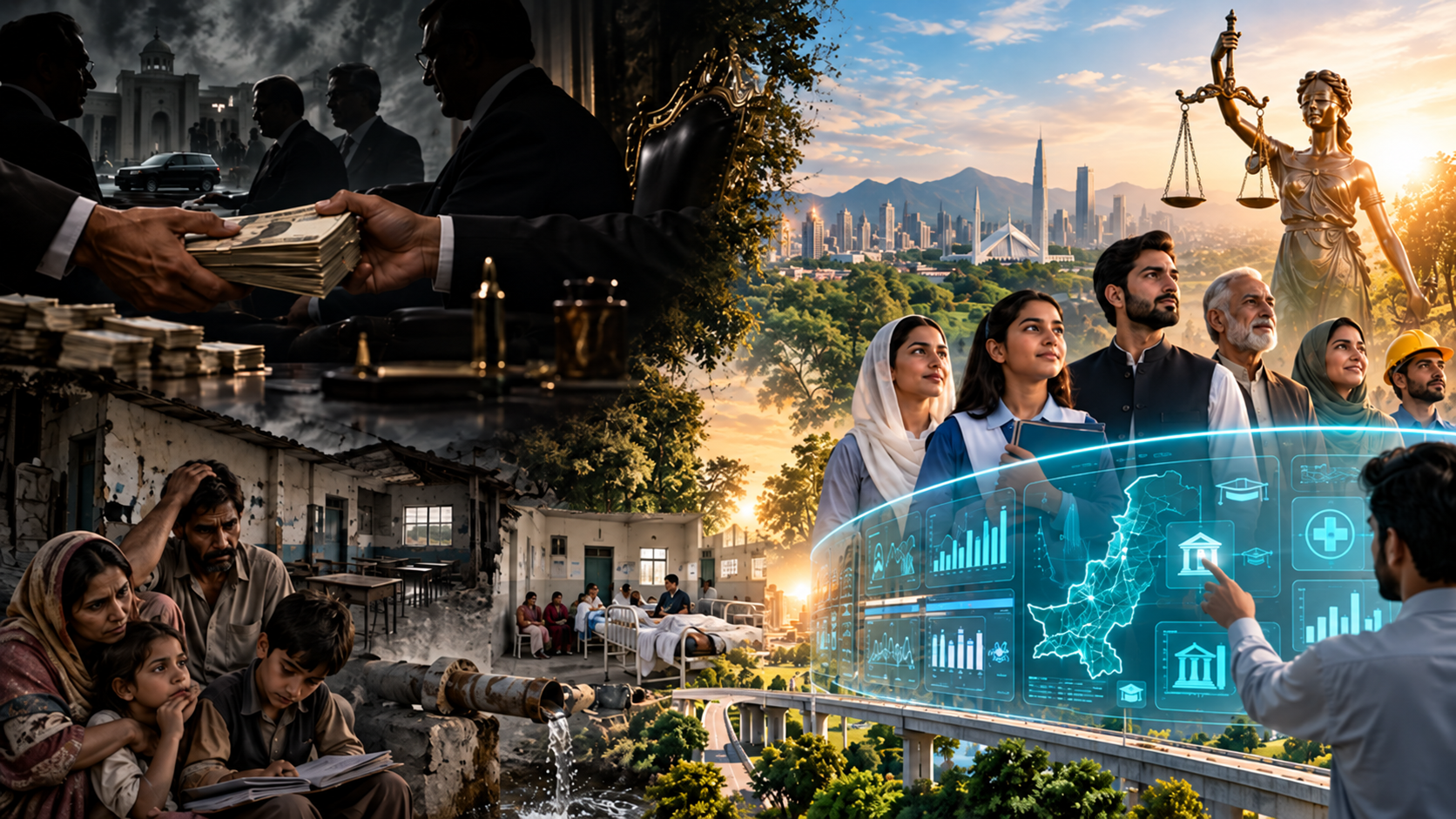
Pakistan needs people who can imagine better institutions, not just criticize broken ones. We need civic education programs, legal awareness campaigns, transparent digital platforms, ethical journalism, youth discussion circles, peaceful community forums, independent research, and technology that exposes corruption instead of protecting it.
Creative imagination turns complaint into construction. It asks us to become builders, not just critics. Anyone can curse the darkness. The real challenge is to light a lamp without setting the whole house on fire.
A National Transparency Platform: Responding with Reform
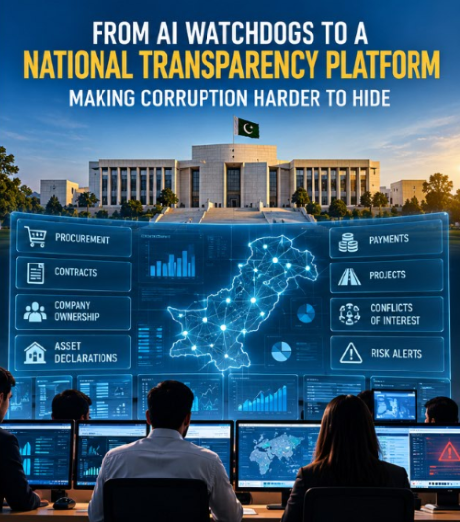
One practical example of responding instead of merely reacting is the creation of a digital National Transparency Platform. As I discussed in my earlier blog, AI, Ethics, and the Battle Against Elite Capture, Pakistan needs systems that make dishonesty harder, not just speeches that condemn dishonesty after the damage is done.
Such a platform could record and display every major government transaction in a structured, searchable, and publicly reviewable form. Government contracts, procurement decisions, land allocations, development projects, public-sector hiring, tax exemptions, subsidies, and major expenditures should not remain hidden behind closed doors. Citizens should be able to see who received a contract, how much was paid, what criteria were used, what progress was made, and whether the outcome served the public interest.
This would not be about insulting leaders or humiliating officials. It would be about helping the state become more credible. A transparent system protects honest officers, exposes dishonest practices, and reduces suspicion between citizens and government. If properly designed with privacy safeguards, independent oversight, and responsible use of AI, such a platform could become a peaceful instrument of accountability. It would allow citizens to respond constructively to corruption and elite capture by demanding visibility, traceability, and fairness in the use of public resources.
How to Speak Without Unnecessary Provocation
Some people may ask: how can we work for improvement without offending the leadership? The honest answer is that we cannot fully control how others feel. Even respectful criticism may offend someone who dislikes accountability. But we can control our own tone, method, and intention.
We can criticize decisions without insulting personalities. We can ask for transparency without using abusive language. We can demand constitutionalism without promoting hatred. We can say, “This policy harms public trust,” instead of saying, “These people are enemies.” We can say, “The law must apply equally to all,” instead of using language that humiliates or provokes.
This is not weakness. This is maturity. A mature citizen speaks firmly, but with dignity. A mature citizen does not confuse volume with courage. Truth delivered with wisdom travels farther than truth wrapped in rage.
What Is in Our Control?
In difficult political times, people often feel helpless. But we are not helpless. We control whether we verify information before sharing it. We control whether we use decent language. We control whether we teach our children courage with manners. We control whether we support honest voices. We control whether we participate peacefully.
We also control whether we become cynical or constructive. Cynicism is easy because it asks nothing from us except complaint. Constructive citizenship is harder because it requires patience, discipline, and responsibility. But if citizens give up on responsibility, then the national decline becomes even easier.
The first victory is internal. A nation cannot become free if its citizens are prisoners of anger, fear, propaganda, and revenge. The struggle for a better Pakistan must begin with a better kind of citizen: informed, disciplined, ethical, and courageous.
The Ethical Path Forward
Pakistan needs reform. It needs rule of law, freedom of speech, institutional balance, accountability, and leaders who respect citizens. But it also needs citizens who act with responsibility. We should not respond to injustice with hatred. We should not respond to censorship with misinformation. We should not respond to arrogance with arrogance. We should not respond to abuse of power with abuse of language.
The real test of character is not how we behave when things are easy. The real test is how we behave when we are angry, disappointed, and under pressure. That is why reacting is not enough. Pakistan needs citizens who can pause, think, choose, and then act.
We need citizens who use self-awareness to understand themselves, conscience to stay morally clean, independent will to remain disciplined, and creative imagination to build a better future. Between stimulus and response, there is a space. In that space, Pakistan can either lose itself further or begin to recover. The choice is still ours.
Conclusion
The political situation in Pakistan may tempt many people toward anger, despair, and reckless reaction. But a nation is not healed by rage alone. It is healed by citizens who combine courage with wisdom, truth with discipline, and criticism with constructive action.
Reacting may give us emotional satisfaction for a moment, but responding can create long-term change. If we want a Pakistan based on rule of law, dignity, justice, and freedom, we must practice those values ourselves even when the environment is difficult.
Call to Action
Let us begin with the space between stimulus and response. Before we post, speak, forward, or protest, let us pause and ask: Is this true? Is this ethical? Is this useful? Is this within my control? If enough citizens learn to respond wisely instead of reacting blindly, Pakistan’s journey toward renewal can still begin — one thoughtful citizen at a time.

Leave a Reply