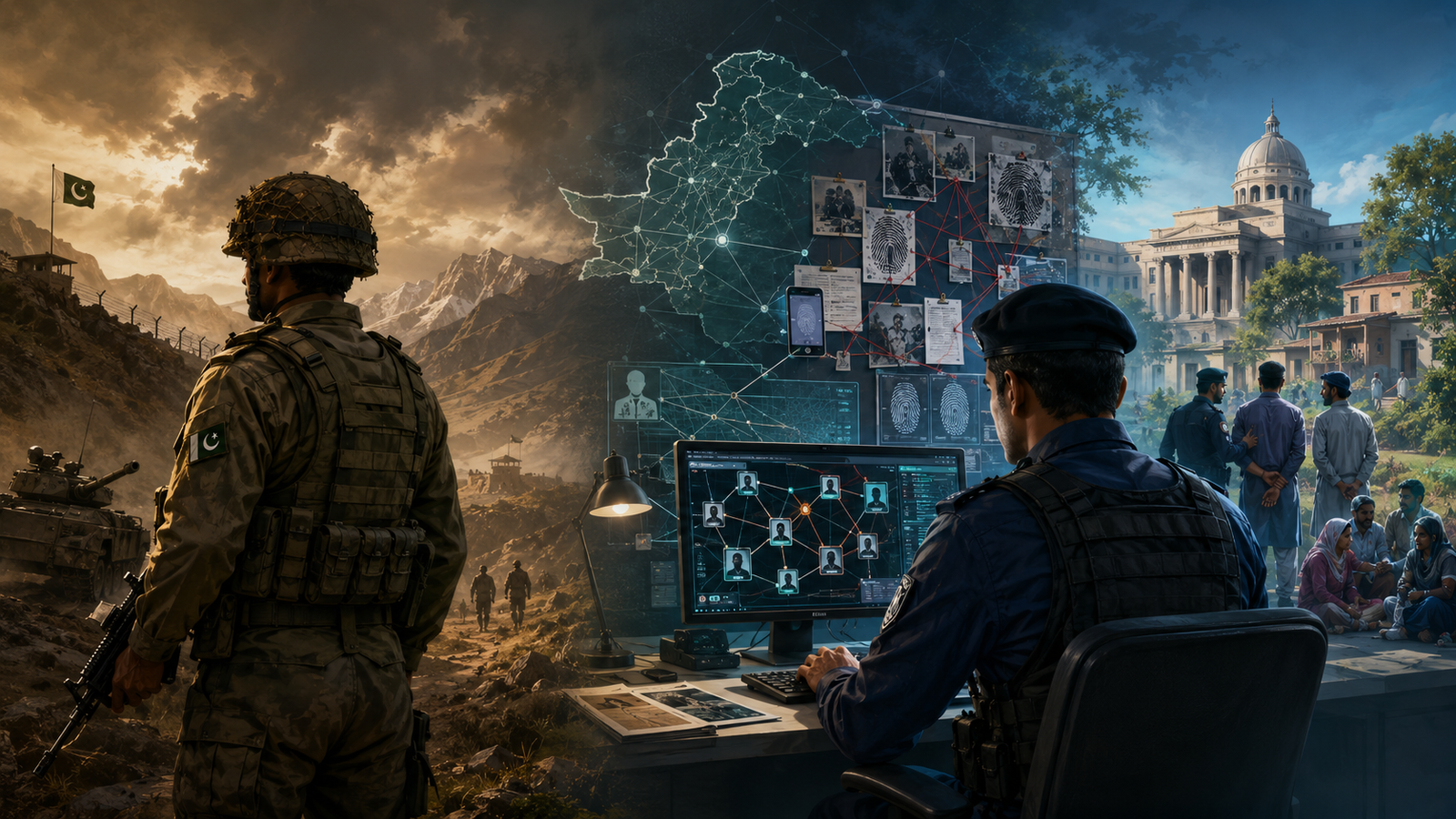
When terrorists attack, the public understandably demands a powerful response. Governments deploy soldiers, establish checkpoints, conduct raids and promise to eliminate every militant. The sight of troops creates an impression of decisive action.
But terrorism is not conventional warfare. An army may capture territory and destroy militant camps, yet still fail to eliminate the networks, financing, recruitment and grievances that allow terrorism to return.
The central question is not whether the military can kill terrorists. It certainly can. The real question is whether an institution designed primarily to fight enemy armies is the best institution to investigate crimes, identify suspects, collect admissible evidence and protect communities over the long term.
Usually, it is not.
A Soldier and a Policeman Have Different Missions
In one of his old videos, Pravin Sawhney’s discussion of the lessons of the Kargil conflict, provides a useful starting point. Kargil was a military confrontation involving territory, artillery, logistics and organized armed forces. These are the conditions for which conventional armies are principally built.
Soldiers are trained to locate an enemy, overpower it, and achieve a military objective. Their doctrine emphasizes firepower, battlefield initiative, operational secrecy and force protection.
Policemen operate under a different framework. Their responsibility is to prevent crime, protect citizens, identify suspects, make lawful arrests, and produce evidence that can withstand scrutiny in court.
A soldier confronting an enemy combatant may be trained to neutralize the threat. A police investigator confronting a terrorism suspect must ask additional questions:
- Who financed the operation?
- Who supplied the explosives?
- Which communication channels were used?
- Are there additional members of the network?
- Can the evidence secure a lawful conviction?
- Were the suspect’s legal rights protected?
That difference is enormous. Terrorists do not normally wear uniforms or assemble their forces on an open battlefield. They hide inside communities, use ordinary financial systems and mix criminal operations with political propaganda. Defeating them requires patient investigation more often than heavy artillery.
Terrorism Is Primarily an Intelligence Problem
The most effective counterterrorism operation is often the one the public never sees. Police and intelligence agencies identify a plot, trace communications, monitor financing and arrest the suspects before an attack occurs.
Local police can be particularly valuable because they remain embedded in society. They know neighbourhoods, families, criminal networks and recurring patterns of suspicious activity.
The Organization for Security and Co-operation in Europe explains that public trust can help useful information emerge through effective community policing. It also warns that community policing should not become indiscriminate surveillance disguised as public engagement. Trust must be genuine, not a trap. OSCE research therefore treats community policing and intelligence-led policing as complementary but distinct approaches.
An army deployed temporarily in an unfamiliar locality rarely possesses these relationships. Soldiers may control roads and buildings, but they cannot quickly manufacture community trust.
When residents fear collective punishment, disappearance or retaliation, they become less willing to share information. The security forces then lose access to the very intelligence needed to identify terrorists.
Evidence Matters as Much as Firepower
A terrorist organization is not merely a group of armed men. It is a system involving recruiters, financiers, couriers, propagandists, safe houses and facilitators.
Killing one militant may stop one attack. A professional investigation can uncover an entire network.
Police counterterrorism units are trained—or should be trained—in forensic examination, interrogation within the law, digital analysis, financial investigation, surveillance and chain-of-custody procedures. Their work connects security operations to prosecutors and courts.
The United Nations Office on Drugs and Crime places criminal investigation, prosecution, international cooperation and lawful evidence-gathering at the centre of its criminal-justice response to terrorism.
This approach matters because a state governed by law cannot treat every suspect as an enemy soldier. Suspicion is not proof. Intelligence is not automatically admissible evidence. Confessions obtained through coercion may be unreliable and can destroy the legitimacy of the entire counterterrorism campaign.
Excessive Force Can Strengthen Terrorist Propaganda
Military operations in Pakistan, more often than not, produce civilian casualties, damaged property, and displacement even when commanders try to avoid them. In a conventional war, force is directed against an opposing armed force. In domestic policing, however, the state is operating among its own citizens.
If innocent families suffer, terrorist organizations can exploit their anger. They present themselves as defenders of the community, recruit new members and transform operational defeats into propaganda victories.
This is why human-rights safeguards are not sentimental obstacles to security. They are part of effective security.
The International Committee of the Red Cross explains that the law-enforcement rules governing the use of force are designed to protect life while preventing crime, making arrests, and maintaining public order. That is fundamentally different from the conduct-of-hostilities model used in armed conflict. The distinction between these legal frameworks should shape both training and operational procedures of police forces, military units, and counterterrorism agencies.
Prioritizing Police over Military Deployment
Pakistan’s military operations have, at critical moments, disrupted large militant formations and recovered territory. Those achievements should not be dismissed. However, clearing an area is not the same as establishing lasting civilian security.
Pakistan’s own institutional structure recognizes that terrorism requires coordination beyond the military. The National Counter Terrorism Authority operates under the Ministry of Interior and is supposed to coordinate national efforts against terrorism and extremism.
Research on Pakistan has repeatedly emphasized the importance of civilian capacity. A United States Institute of Peace study on Pakistan’s police stations and counterterrorism concluded that success rests heavily on the police’s ability to gain community support—not merely on receiving better weapons and vehicles.
Pakistan therefore needs properly funded provincial Counter Terrorism Departments, modern forensic laboratories, protected witnesses, competent prosecutors, coordinated intelligence databases and police officers recruited from the communities they serve.
Does the Military Have Any Counterterrorism Role?
Yes—but it should be clearly defined.
The military may be necessary when militants control territory, possess heavy weapons, attack across an international border or conduct operations beyond the capacity of ordinary police. Soldiers can also provide bomb disposal, aviation, surveillance, hostage-rescue and emergency logistical support.
Even NATO acknowledges that military forces can contribute to counterterrorism. But it also stresses the importance of police coordination, specialized training, civilian trust and an accompanying political strategy. NATO has warned that disproportionate force without suitable training can become ineffective or counterproductive. Its discussion of the military’s counterterrorism role supports a comprehensive response—not military dominance.
The proper model is therefore police-led, intelligence-driven and judicially supervised, with the military providing exceptional support when the threat exceeds civilian capacity.
The Real Victory
Terrorism ends not when the largest number of suspects have been killed, but when terrorist networks can no longer recruit, finance operations, intimidate communities or escape justice.
An army can win a battle. It can clear a valley or destroy a hideout. But only functioning civilian institutions can preserve peace after the soldiers leave.
Currently, in Pakistan, almost every counterterrorism operation is conducted by the military. This heavy reliance on the armed forces should be avoided whenever possible, and the police force should be actively involved and prioritized instead.
If Pakistan wants sustainable security, it must stop treating police reform as a minor administrative issue. Building trusted, capable and accountable police forces is not a softer alternative to fighting terrorism. It is the harder—and ultimately more effective—road to defeating it.
What do you think? Should Pakistan’s counterterrorism strategy become primarily police-led, with the military reserved for exceptional threats? Share your views and help continue this important national conversation.

Leave a Reply