
A blueprint for an AI-supported National Transparency Platform
The Problem With Saying “This Is Wrong”
In Part 1, I argued that Pakistan’s war on corruption has to start with a moral decision: stop treating corruption as normal.
But here’s the uncomfortable truth — moral outrage doesn’t track a missing payment. It doesn’t compare ten thousand contracts side by side. It doesn’t tell you whether the hospital that was “completed” last year actually has walls.
For that, you need a system, not a slogan.
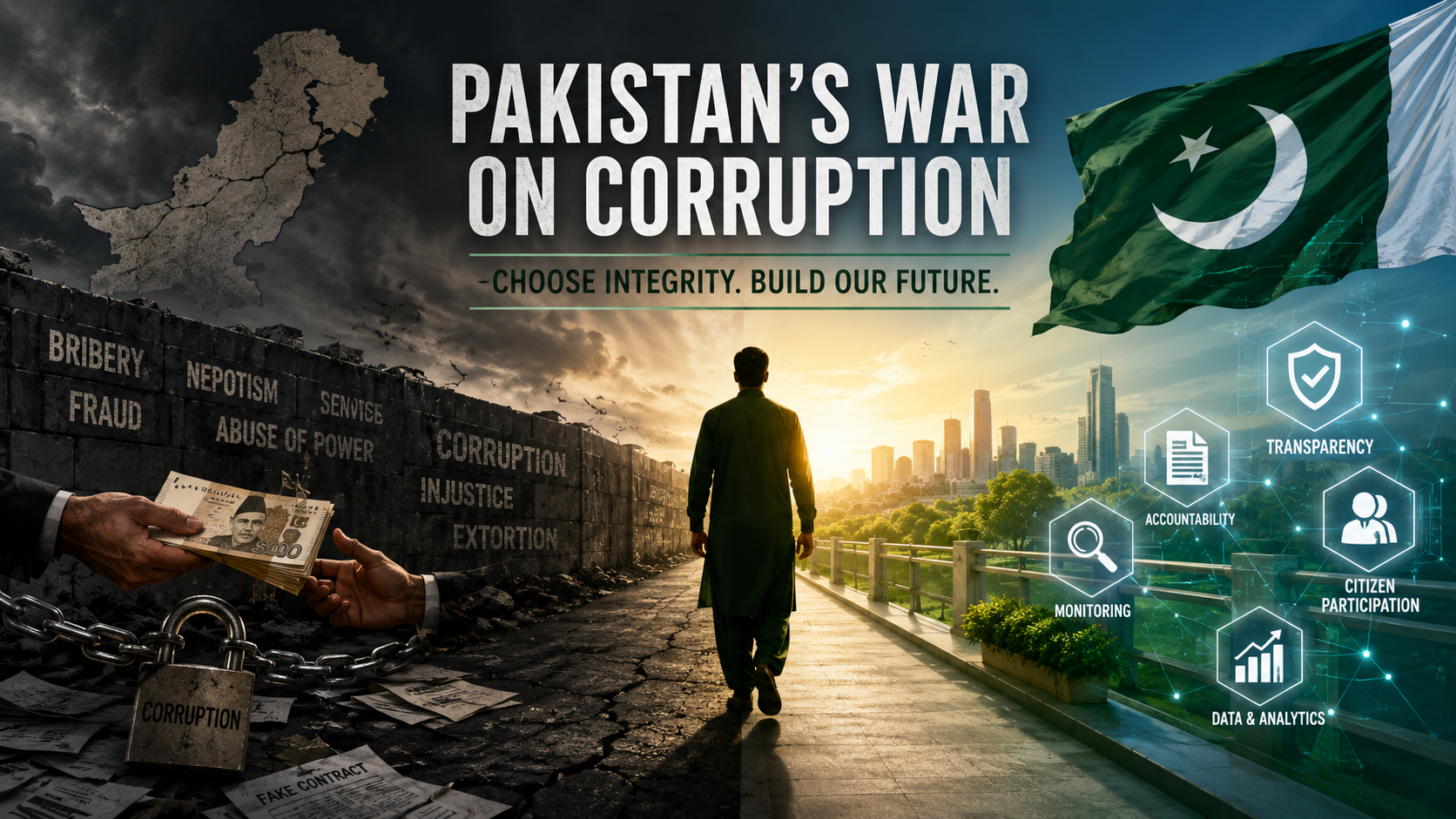
So here’s the proposal: an AI-supported National Transparency Platform — a secure, public-interest system that connects government budgets, procurement records, payments, company ownership, development projects, audits, asset declarations, and service-delivery results into one traceable chain.
Its job would be simple: make public money easy to follow and hard to hide.
One thing this platform would not be: a magic wand that “ends corruption.” And artificial intelligence should never be allowed to accuse or convict anyone. AI organizes evidence and flags unusual patterns. Human investigators review it. Courts — not algorithms — decide guilt.
Pakistan already has most of the raw records it needs. What’s missing is the connective tissue: standardization, publication, and a guarantee that no powerful institution can quietly switch off the light when things get uncomfortable.
Why Corruption Loves a Filing Cabinet
Government departments generate an enormous paper trail — budgets, tenders, contracts, invoices, land records, audit objections, company registrations, project reports. The problem isn’t a lack of records. It’s that they live in separate systems, incompatible formats, and get released too late to matter.
A road contract might sit in one department. The contractor’s registration lives in another. The final payment record is in a third. By the time an audit flags something wrong, the officials involved have moved on — and the money has too. Fragmentation is corruption’s best hiding place.
This isn’t just an opinion. The IMF’s 2025 governance diagnostic on Pakistan pointed to persistent corruption risks, fragmented oversight, weak procurement controls, insufficient coordination, and limited access to information, and recommended greater transparency, stronger disclosure of beneficial ownership, risk-based approaches to prevention, and smarter use of technology.
Pakistan’s problem isn’t a shortage of investigations. It’s a shortage of connected, timely evidence.
What the Platform Should Actually Show You
Picture a system where any citizen, journalist, auditor, or legislator could follow a rupee from approval to result. For every major government project, it should answer:
- What was approved, by whom, and why?
- What was the original budget — and how many times did it change?
- Was there real competition? How many firms actually bid?
- Who won, and who really owns that company?
- What amendments, extensions, or cost increases got approved later?
- How much has been paid, and against which verified milestone?
- What was actually delivered — and where’s the proof?
- What did auditors find, and did anything happen because of it?
Every project would carry a permanent digital identity linking its budget, tender, contract, payments, completion reports, geotagged photos, audit findings, and public feedback — all in one place. Nobody should need detective skills just to find out where their tax money went.
Some things genuinely need protection: personal data, real national-security concerns, active investigations, narrowly defined trade secrets. But “confidential” can’t keep functioning as a blanket thrown over every embarrassing transaction. Even when operational details stay restricted, the total cost, contracting method, responsible institution, and audited outcome should still be visible.
Start Small: Public Procurement First
Procurement is the natural entry point, because big money moves through the same repeatable stages every time: planning, tendering, bidding, award, delivery, payment, audit.
Pakistan already has a foundation here — the Public Procurement Regulatory Authority runs the e-Pak Acquisition and Disposal System and has adopted the Open Contracting Data Standard to improve transparency and public access. That’s worth building on, not tearing down.
The next step is making standardized, searchable publication the norm across federal — and eventually provincial — entities, covering the whole process, not just the tender notice. A competitive bid can quietly become an expensive one through repeated “amendments” nobody sees coming.
The platform should also cross-reference procurement data with beneficial-ownership records. Five bidders secretly run by the same person? That’s not competition, that’s theater. A brand-new company with no track record winning major contract after major contract? That’s a pattern investigators should see immediately — verified lawfully, with a clear path to correct any inaccurate record.
What AI Can — and Absolutely Cannot — Do
Once the data is connected, AI can scan millions of records faster and more consistently than any audit team. It could flag things like:
- Repeated single-bid contracts in one department
- Bids suspiciously close to the official cost estimate
- “Competing” companies sharing addresses, directors, or bank details
- Contracts that land just under the threshold requiring extra scrutiny
- Costs that balloon right after the contract is signed
- The same vendor winning despite a bad track record
- Payments released before milestones are actually met
- Projects marked “complete” with no credible evidence
- Wildly different prices paid for the same basic goods
- Hidden networks linking officials, vendors, and property
These are warning lights, not verdicts.
A single bidder might be completely legitimate in a specialized market. Costs can rise because of inflation, floods, or a genuine design change. A shared address might be a coincidence.
Every single alert needs to lead to human review, access to the underlying evidence, and a real chance for the accused to respond.
Think of AI here as a smoke detector, not a judge. A smoke detector tells you where to look. It doesn’t convict the cook.
Give Citizens a Window, Not a Landfill of PDFs
Dumping ten thousand unreadable PDFs online and calling it “transparency” is a trick, not a reform. Information has to be understandable to count.
The platform should offer simple dashboards in Urdu and English (and regional languages where possible), searchable by district, department, contractor, constituency, project type, or funding source.
Imagine a woman finds the water project near her house on a map. She sees its cost, contractor, timeline, payments, photos, and the official responsible. If it exists only on paper — or is already falling apart — she submits a geotagged photo and a complaint, right there.
Citizen reports still need professional verification — photos can mislead, and complaints can be weaponized against rivals. But local residents are usually the first to know a school has no roof, a clinic has no medicine, or a “finished” road stops dead after two kilometers.
The platform should then publish what happens next, at every step: complaint received → preliminary check done → referred for audit → closed (with reasons) → recovery ordered → prosecution recommended.
Citizens may not get every confidential detail. But silence should no longer be an acceptable government response.
Protect the Whistleblowers, Not Just the Whistles
A transparency platform fails instantly if reporting corruption is riskier than committing it.
Pakistan needs real whistleblower protections: secure reporting channels, confidentiality guarantees, penalties for retaliation, and independent review for complaints touching powerful people.
It also needs to protect the honest official — the one who says “no” to an improper order and then gets quietly transferred, isolated, or hit with a manufactured allegation.
A digital approval trail helps here too: who authorized what, who objected, what evidence was considered, whether procedure was overridden. That protects the public — but it also protects an honest civil servant from becoming the scapegoat for someone else’s decision.
Anonymous complaints should be allowed, but they shouldn’t become public accusations automatically. Evidence gets assessed confidentially, then names are released if warranted. The goal is accountability — not a new arena for character assassination.
The Real Question: Who Guards the Platform?
This is the part that decides whether the whole idea is a reform or a trap.
A powerful transparency system fully controlled by whoever happens to be in government could easily become a tool for surveillance, selective leaks, or political revenge — scrutinizing rivals while shielding allies. That wouldn’t reduce corruption. It would just digitize the injustice.
So the platform needs real institutional independence. Its governing board should include the Auditor-General, procurement authorities, federal and provincial representatives, independent technical experts, civil society, the legal profession, academia, and business — with no single party, ministry, accountability body, or security agency controlling appointments, data removal, or access.
Its own operations need to be visible too: which datasets are missing, how the risk indicators actually work, how often they produce false alarms, and who accessed sensitive records. Independent audits should regularly test its security, political bias, data quality, and potential for misuse.
And the same disclosure rules must apply to every institution spending public money or exercising public authority — with only narrow, reviewable exceptions.
Selective transparency is just a fancier name for selective accountability.
Privacy, Accuracy, and the Right to Push Back
Connecting massive government datasets is powerful — and risky. A poorly designed system could leak identity records, financial details, or home addresses. It could also wrongly link an innocent person to misconduct simply by matching the wrong records.
Privacy and due process have to be built in from day one: public versus restricted data clearly separated, sensitive access role-based and logged, encryption and security testing standard, breach reporting and real penalties for misuse.
Anyone flagged by an automated system should be able to learn why, challenge inaccurate data, submit an explanation, and get an independent review. High-impact models need to be explainable enough for auditors and courts to actually examine them.
Secret algorithms must never become secret witnesses.
Build It in Stages — and Prove It Actually Works
Trying to connect every government system on day one would produce an expensive mess and a very impressive ribbon-cutting ceremony. Pakistan has had enough ceremonies. It needs results it can measure.
A sensible pilot would look like this:
- Pick one high-spending sector — roads, health procurement, or municipal development.
- Bring in a limited group of cooperative federal and provincial entities.
- Publish standardized data from planning through completion.
- Link contractors to verified ownership and past-performance history.
- Introduce a small, independently reviewed set of risk indicators.
- Give auditors, journalists, businesses, and citizens structured access.
- Publish the pilot’s results — including its errors, costs, and false alarms.
Then let the evidence decide whether to expand. Did competition go up? Did single-bid contracts drop? Were suspicious payments stopped before release? Did audits get faster responses? Were projects finished closer to budget and schedule? How many AI alerts were actually useful — and how many were noise?
If a system can’t answer those questions, it isn’t accountability. It’s just software with a good PR team.
Technology Can’t Do the Rule of Law’s Job For It
No platform survives if investigators are pressured, records are faked, courts can’t rule fairly, or powerful people stay exempt by design.
Technology can expose a suspicious payment. It cannot manufacture courage inside an institution that’s been ordered to look away. It can preserve a digital trail. It cannot force a court to act on it.
So the platform has to be paired with broader reform: independent accountability bodies, professional investigators, timely courts, credible audits, transparent appointments, political-finance disclosure, real access-to-information laws, and actual consequences for proven wrongdoing.
Pakistan doesn’t need another temporary crackdown on convenient enemies. It needs prevention paired with consistent enforcement.
Corruption is partly a moral failure — but systemic corruption is also, quite literally, an engineering problem. Any process built on personal discretion, hidden paperwork, untraceable cash, and disconnected databases has been designed — intentionally or not — to invite abuse.
Better design shrinks the opportunity. Clear rules, digital records, open competition, automatic checks, and visible decisions make honesty the easier path and corruption the riskier one.
From Helplessness to Public Ownership
Pakistan’s war on corruption won’t be won by one leader, one general, one judge, one accountability agency, or one piece of software.
Institutions built around a single heroic figure tend to collapse the moment that figure leaves. Durable reform has to belong to the public, and it has to keep working no matter who’s in office.
An AI-supported National Transparency Platform is a practical way to turn moral rejection of corruption into daily, visible accountability. It wouldn’t assume every public servant is dishonest — if anything, it would help honest officials prove their decisions were lawful and fair. It wouldn’t replace investigators, journalists, auditors, or courts. It would just hand them better evidence.
And it wouldn’t promise perfection. It would make concealment harder, detection more likely, and public oversight actually mean something.
Part 1 said the war against corruption begins the moment citizens find the courage to say, “This is wrong.”
Part 2 adds the next line:
“Now let’s build a system that lets us see it, prove it, prevent it, and respond to it — fairly.”
This is a long project, and it needs technologists, auditors, lawyers, civil servants, journalists, businesses, academics, and ordinary citizens pulling in the same direction. I plan to keep developing this idea and sharing where it goes.
Have expertise, a sharp objection, or a constructive idea? Join the conversation in the comments below — Pakistan doesn’t lack honest people. It lacks a system that helps them find each other, protect each other, and act together.
The technology exists. The talent exists. The need isn’t up for debate.
What’s missing is the will to turn transparency from a slogan into national infrastructure.


Leave a Reply